Showing posts with label classroom management. Show all posts

Thursday, 20 April 2017

Empower Your Learners by Lending an Ear to Your Pre and Primary Class

Pre and Primary classrooms are not just teacher to student interaction. Rather it’s both way and teacher plays a vital role of a listener and thus empowering the students in the learning process. Hence good listening skills are needed to develop empathy and understanding with the students, and also must have the ability to assess whether they understood what are being taught.  Listening skills also help in negotiating with students and defusing a suddenly erupt classroom conflicts. 


Listening is a two-way process wherein the teachers not just only do the talking but also listen to the students. As the students spend a lot of time listening to the teacher, this enhances their listening skills. Both the teacher and student learn from each other. The practice should be such that students develop their own educational plan which involves searching and finding solutions to their everyday queries and problems generated. They must never consider the teachers as the fountain of all knowledge. 
The teacher must have the ability to empathise with the student’s viewpoint. Even then personality clashes, differences, status gap between teacher and student etc may rise and thus obstacle the listening and communication between the teacher and the student.  To reduce tension in the classroom the teacher must introduce empathetic listening in the classroom. He/she must promote honest communication and build trust and confidence among themselves.
21st century teachers need to cultivate a range of skills apart from teaching methods to support the learning goals of all children.  Diploma in Pre and Primary teacher training designed meticulously to produce efficacious educators who would understand the need of the students.  These educators must exhibit following characteristics to display genuine desire to understand:-
  • Be attentive and not easily distracted.
  • Create positive atmosphere with non verbal behaviour like body language and facial expressions.
  • Act like a mirror, by reflecting what exactly you are feeling.
  • Show that you are never in a hurry and maintain silence throughout teaching, as this gives students opportunities to think and reflect on questions and topics in their mind before verbally giving an answer.
  • Never get emotionally involved, angry, argumentative and upset. Always maintain a professional attitude while you interact with students, as you are their role model and children look up to you for directions. 
  • Never jump to conclusions and judgement about any student.
  • Avoid pre-conceived ideas about a student based on what you have heard from a colleague or former teacher.

Always show that you are listening. Lend you ear in their learning process. This can be done by encouraging acknowledgements like ‘Yes’ or ‘I see’ or simply by nodding. Even without any verbal communication you can show that you are listening like eye contact, facial expression or relaxed body postures. And always remember to invite more responses from the students and thus encouraging them to speak up with full enthusiasm. Use of words- ‘tell me more’ or’ I’d like to hear about that’- words works like magic. Never interrupt or change the subject as this is very discouraging.  
Thus the pre and primary teacher training course prepares you to handle the most important aspect of communication. You stop to teach or preach or just give an advice, you learn to become silent speaker. Hence the teacher becomes their friend rather a better educator from whom they learn in a playful manner. As the educator never speaks down to them, they can sense the teacher is not above their level and they would stop responding. They find it rather easy to communicate with this teacher. This improved motivation helps in the fulfilment of the learning goals.
Join the course and learn the modern techniques of teaching and grow on your skills. Classroom management is not an easy task; you have to master the skill to deal with students of all levels and behavioural pattern. Listening skill is something you must work on while you pursue the course. Candidates enrolling from different backgrounds must keep one thing in mind. This learning and teaching process is not about the subject matter i.e., ‘not what you teach but how you teach’. 

Monday, 27 March 2017

Boons of Having a Lesson Plan

A playgroup classroom loaded with eager eyes is like a race of wills, and if you go inattentive even for a second, you lose. Kids as well see when an educator fails to realize what to do and if you give hint of ineptness, they will jump. With a classroom loaded with devious youngsters, with their limited capacity to focus it is essential to arm yourself with traps and thoughts to keep them into the class. When you know your objectives then, you can configure suitable learning exercises and create techniques to get great input.  As a result a lesson plan is your best weapon in that fight. A lesson plan is a teacher’s guide of what the children should learn and how it needs to be done viably amid the class time. An effective lesson planning addresses and incorporates the key segments of learning and development. Before you arrange your tutorial for the class, you will firstly need to recognize the learning purpose for the class and the children. You ought to know and in addition make the children know the significance of the class and connect with them in an inventive method.


Lesson plan arranges an inventive classroom and helps to instruct the children viably. When you have indicated solid targets for the children learning, the lesson plan will help you decide the sort of instructing and learning exercises you will use in class. The lesson plan will likewise help you characterize how you will check whether the learning targets have been proficient and helpful. Lesson Plan gives the educator a more prominent affirmation and more prominent flexibility in instructing outstandingly while educating kids. The educator with an equipped and arranged lesson instructs sensibly, goes into the classroom without tension. A lesson plan helps you prepare to walk off with certainty and be competent to convey it to the children.
Arranging out a lesson plan also gives the children a promising condition to think about the chapter and react. Children are to a great extent anxious and a snapshot of instability among the teacher can prompt to total rubble by making confusion. Thus an incredible lesson plan can be more noteworthy arm with a preparation. You ought to make a lesson planning while guaranteeing that the exercises methods you pick meet your objectives of supporting every kid's level of development and advancement. It is essential to have the learning goals as a top priority since it drives the improvement of the children through the best possible execution of all exercises in the classroom.
If you are an early childhood educator, your lesson plan will help you with a nitty gritty arrangement since it will make you visualize each class before you get in. Before you draw a lesson plan you have to identify fruitful and more effective exercises during the class time and the exercises would make it less challenging you to acclimate to the possibilities of the child's class room. You can take assistance from the senior educators if who have a greater tribulation about the class room management. The lesson plan fits for an additional input on arranging and management of the class time. A lesson plan additionally helps the educator to know the most alluring sort of teaching methods and to plan the class room in advance. A nursery instructor teacher training prepares the confident educator with the best guide for arranging a productive lesson plan.

Tuesday, 20 December 2016

Excellent TEFL Opportunity in the Land of Diversity - India

Demand for learning English has increased big time in most of the countries and India is one of them. The increasing demand for quality English teachers in India has created huge opportunity for the EFL teachers to find quality teaching job. Pursuing a Post Graduate Diploma course in TEFL can help you big time to find TEFL job in India. You will be awarded a globally recognized certificate that will help you to find job as it will appear as the proof sheet for your teaching capability and knowledge. The course will help you to understand the teaching English as a foreign language methodology. It is different from traditional teaching. Hence you need to learn the approaches to grow as an EFL teacher.


Apart from the knowledge on teaching methodologies, the course will also guide you to know other important aspects of teaching as well. It will comprise the important skills of developing strategies to teach in more effective way. Classroom management will be another important part of the course that you need to learn in order to create favorable leaning atmosphere. The learning atmosphere has a huge part to play in education as it appears as something useful for both teachers and learners. The quality of education also depends on the atmosphere.
The certificate will play a crucial role to find quality teaching job though it is not mandatory but it will surely help you to find job by creating better chances over other applicants. As the certificate is globally recognized hence you can apply for teaching job in every part of the world. India is undoubtedly one of the most important and popular destinations for EFL jobs and you will require the certificate to find job easily. The knowledge of teaching will also become important in your future career. Teaching in India is absolute fun and gigantic experience.
There are a number of reasons for the aspiring and working teachers to elect India as the destination for TEFL jobs. The most important reason is there are numbers of TEFL jobs available in India as the country is an important part of the global market and a vital player in the tourism business. Hence it is easy to find TEFL job in India. The salary structure for EFL teachers is relatively higher than other countries featuring TEFL jobs. The working teachers can earn handsome amount at the end of the month that they can save and use to explore the country and fund their future studies to flourish career opportunities. 

The country India is rich with scenic beauty and natural diversity. While you are working as an EFL teacher in India you can explore the beauty of the country. The rich history in India and evident left of it can dazzle your heart in no time. You can spend some quality time on the beautiful beaches and enjoy the serenity over there during your days off. You can take part in the cultural practices and experience something unique on its own way. The natural diversity along with different lifestyle and languages in India is the most special attraction. If you are willing to explore India at its best then you simply cannot miss out trips to breathtaking hill stations in India. It will bring ultimate peace to your mind and restore energy within you to work tirelessly and gather more beautiful experiences. Indian food possesses a huge popularity all across the globe among food lovers. You can have a great time teaching in India with the typical taste of Indian food. Every corner of the country has something unique taste to offer. The roadside fast foods are extremely mouthwatering and delicious.

Wednesday, 3 August 2016

Organization of Classroom Materials is a Challenging Task

teacher training course,A well organized classroom is difficult to achieve but are practically beneficial to children engaged.  A classroom where files, supplies, forms are systematically kept, where a student record can easily be picked up at any moment a substitute teacher can come in and start from the point where it has been left off without any hitches. Few steps can be followed to achieve organised classrooms.


a.    Resources and Materials to be organized: - Begin with putting colour code for everything. Use colour papers or coloured labels on resource books for students so that they can return to the right notebook. Also place your teacher resource books in three-ring binders using plastic sleeves. And then colour code this binders according to the subjects. Store all the items like holiday projects, art projects, special books and supplies in plastic tubs or cardboard file boxes. And then label these boxes with the name of the each project.

b.    Organise student records: - As you receive the students list, set up a system that will allow you to access student records quickly and easily.
Assign the same numbers to each student that you have marked in the grade book. Make sure student write his or her number on every assignment. Now use this corresponding numbers to label all student materials even the mailboxes. It is preferable to have online grade books to automatically assign students and record their grades.
For every new student be prepared in advance with packets of information when that kid enters the classroom in the middle of a session or lesson.
The seating arrangement should be charted as soon as the class list is final. Thus you will be able to remember students’ name and help keep some order in the classroom.


c.    The students need to be trained:  When your students have adequate knowledge about the classroom rules and procedures which they have to maintain throughout the school session.
Besides include classroom standards such as cooperation and routines, assignment turn-in and work standards. She or he should always become familiar with the district rules like suspension or school behaviour codes.
Explain students about class organization to students. Make sure they know where to find materials and supplies and know how to put those back. Encourage them by rewarding for following directions of the teacher.

Classroom material management involves active participation from the students. Teacher’s role to prepare everyday activities by planning ahead, and check that minimal amount of stress can be produced during those activity performances. Teacher should create a substitute teacher folder or binder in advance in case of his or absence due to health conditions like flu etc. Includes notes on students to assist in certain areas. And finally, label your cabinets so that the substitutes can easily find supplies or materials they need. 

Elementary teacher training prepares you to handle diverse classrooms most effectively. The ideas are very simple, cost effective and an endeavour to use re-cycled everyday materials commonly found. The USP of the course is that it puts together the materials in one place- thus saving time and energy in looking for ideas from internet and other sources. This course will be immensely helpful for aspiring and experienced teachers as this course focus on areas that will make learning effective and teaching memorable.

Saturday, 16 July 2016

Study Education if You Want to Become a Teacher

A diploma course in education is your route to becoming a teacher. Diploma in Education prepares teachers to teach in schools both primary and secondary or teach in an adult education sector. This course is a pathway to become an excellent teacher having both theories and practical experiences that equip one to gain leadership skills.


The programs are thus developed to familiarize the trainees with the educational theories and practices required to understand the learning needs of the students. The course thus helps trainees to gain greater insight into various components like educational psychology, care and nutrition, classroom management and educational administration resulting in a perfect learning environment.
There are huge opportunities for teaching professionals who have completed Diploma in Education and have passion for teaching young learners. With the rising demand for teachers in the ever flourishing pre and primary educational sector, certified teachers have huge scope and opportunities.
The course is immensely helpful for pre-primary curriculum developer, course coordinator, consultants and even entrepreneurs planning to open a school. Thus it’s not just for pre and primary teacher but connecting with the pre primary education altogether. 
Read More: Course in Education Develops Your Understanding and Knowledge
Diploma in Education course offered by ACT has flexible mode of learning. The trainees get complete freedom to learn at their own pace and can even clear their doubts when required from the tutors. The tutors are experienced and always eager to guide their students to achieve their learning goals.  One can email or call for academic assistance or can communicate through WhatsApp, Skype or Hangouts.
Aspiring teachers who desire to teach in pre-primary teaching arena or experienced teachers looking to upgrade their skills are advised to take up this course of diploma in education.  They will gain knowledge of new teaching methods and techniques along with understanding educational psychology, care and nutrition, decision making and other administration issues.
The course materials are really very useful. Similarly the MCQs at the end of each phase give an opportunity to revise everything you have learned. The positive feedbacks from trainers or coordinators boost their confidence. As the course is of short duration, it is convenient for many candidates to enrol in the course. The one year program prepares you in all aspects in becoming an effective educator.
The trained teachers now can confidently apply for job vacancies across the globe. Since Indian educators have a global appeal, they can emerge as a successful teacher.  Diploma in Education is an add-on to your CV because the program from ACT has accreditation from international educational bodies. The globally recognized certification helps you to teach and travel abroad. 
Read More : Computers in Classrooms Benefit Students' Learning
The theories are stepping stones while the teaching practices are the pillars in your career as a teacher. During the internship programs the trainee teachers get to visit various schools, meeting young learner and their performance is observed by expert academicians.  The school experience programs help them to understand their shortcomings and overcoming those. Thus the Diploma in Education program from ACT could help you to become effective teacher. There has been scarcity in terms of effective teachers compared to requirement in schools in this educational decade. ACT’s contribution in this time has been acknowledged for preparing qualified and efficient teachers.  ACT has stand out in the crowd by maintaining its high standard of training and teaching and is a well-known name today in the field of teacher education.

Wednesday, 13 July 2016

How to Teach Young Learners Phonics

Phonics, the sounds and letters that make up language, is the main method of developing young learners learning skills. Phonics is useful for new language learners to break down words into individual syllables, pronunciation accuracy improvement. As teaching phonics means developing a relationship better with letters and sounds, thus enhancing learner’s pronunciation skills.


Phonics can be absolutely fun in learning with inclusion of various games, songs, videos and other activities. There are several ways to develop their skills-
Visual representation of letters: Initially the learners must learn to identify the sounds in correspondence to that letter. In this regard alphabet charts are very useful, as children get easily attracted to colourful things. Children learn by listening to their teachers as they say each letter sound and then repeat those immediately after the teacher. Teachers must make explicit connections between sounds and letters by way of saying and pointing at letters simultaneously. 
Read More: Phonetics is an Important Part of Language Learning
Clapping and tapping: This could be a useful strategy in separating words with individual syllables. You can perform with help of your fingers, hands or any object like stick. While you introduce this concept, you should model clapping or tapping. Like when you take example of balloon and break the syllables by reciting two words- ba-clap-loon-claps. At once children learners the activities and they promptly perform those by their own. Thus in this process they get engaged with words.
Keywords as meaning of words: Keywords substitution activities use familiar songs as a basis for playing with words. After singing the song, with the new lyrics the teacher should discuss with learners how sound shift changed the meaning of the song. As children loves to sing, then song can be absolutely helpful in familiarizing the pattern. This also enhances the memorizing skills.
Flash cards: As a fourth strategy you can make use of flash cards. Picture flash cards are excellent tools for children who lack the skills to develop their phonemic awareness. So a teacher’s prime task lies in creating various picture flash cards that are familiar to the child. And put a little test by asking the children the names of the pictures flashed on the cards. After saying the word, the children are asked to identify the first and second sounds in the word. This activity can be immensely useful for children to realize that words are made up of series of independent sounds. 
Read More: Usage of Flashcards in a Young Learner's Classroom
Thus phonics strategies are beginners of English speaking people or new speakers of other languages. These are common but effective techniques for teaching phonics to young learners.  Elementary teacher training could equip you with this techniques to teach students read and understand properly which could be a head start towards better communication. There is a whole new approach to learning phonics and more precisely, language. A preschool teacher must not just be aware of these but know how to implement those.  In this process the teacher plays a prime role in developing the literary skills of a student in an ESL classroom.

Tuesday, 21 June 2016

Usage of Flashcards in a Young Learner's Classroom

Introduction of vocabulary to young learners needs special attention. It is a good idea to use real items to engage and involve them.  But it is not always possible or even realistic for teachers to present real items in the classroom. Flashcards could be a great way out in such a situation of introduction of new vocabulary as that the learners can have better understanding of the word or concept.
While introducing flashcards or picture cards in the classroom, try to build up a story by creating mystery or suspense about the cards. This adds to their curiosity and they tend to show their interest in learning. Rather than just flipping the cards and making them repeat words after it, incorporate the cards in various activities. Thus it will be engrossing and eventually the students will remember the words.


Now repeat the vocabulary learnt in other activities or as a part of other lesson that could be story book reading, preparing a worksheet or song. Allow the students to display meaningful gestures while singing together and in the due process practice vocabulary lessons.
Read More: Design Games to Teach Grammar to Young Learners
Some of the ways to introduce and review kid’s learning using flashcards:-
1-One of the simple yet ideal measures to engage student’s interest is by introducing a new item with a Mystery Box. And they give them hint about what is inside and let the student guess.
2- Go through the picture cards and then pick the one which you think will attract attention of the students due to its familiarity. Now place two cards on the floor of the classroom. Then divide the students into two teams and then line up and hand them an eraser to each of the students standing in the front. Now the teacher will call out one of the cards & two students will have to place the eraser on the correct card. Then whoever achieves it first, will win a point for his team. Repeat this several times with more cards while you introduce such vocabulary that are known to the students in the classroom and that point gives them vocal hints. 
3- In a comfortable classroom ambience make the students sit in a circle along with the teacher. The teacher initiates the game by passing the card to a student saying- this is a horse. The student takes the card and passes on to the next student repeating the same. The card passes across the classroom of students in circle. The card returns to the teacher in the same manner, he keeps it aside and passes a new card to the student with another introduction. This can be played tactfully by passing more cards or stopping them halfway and then passing a newer one.  In this game the students tend to learn vocabularies.
4- Choose six picture cards and number them 1-6 with a whiteboard marker and place them on the whiteboard with magnets. Divide the class into two teams. Then ask one student to roll the big dice which the entire class would watch eagerly which number comes up. The first student to say the name of the vocabulary card with the same number of the dice will win points for his own team. If no one knows the answer, make the student learn it and then repeat the game till everyone correctly knows all the names. When such situation arises introduce set of new cards.
5- Take two sheets of paper same as the picture cards. Make several holes randomly on one of the sheets. In the second sheet cut larger holes in the same spots. Cover a flashcard with this second sheet and at the top place the first one with small holes. Now as one looks at the picture could see only a part of it. Now the game would be to guess the whole picture while you slowly remove the large holed sheet gradually bit by bit.
The above mentioned activities can be immensely fruitful in engaging students. You can prepare some more activities based on your experience during Montessori teacher training. The courses on young learners prepare you adequately to deal with such difficult and diversified classroom.

Friday, 17 June 2016

A Montessori Teacher is a Keen Observer of Children's Activities

A Montessori teacher’s role is not just teaching but work as a keen observer of child’s activities leading to overall growth and development.  The Montessori teachers are the prime driving factor in the classroom. Initially they prepare and organize learning materials to involve the children in those activities and then observing those and guiding them in the learning process. 
 

Working as a facilitator and a guide, the Montessori teacher prepares a Montessori environment and an atmosphere that mostly designed to move students out of their comfort zone into one activity to another.  Now the teacher steps back a little allowing the students to learn from their own discoveries and draw their own conclusions. The teacher would initiate their thinking by asking them critical questions like how they would solve a problem, and thus enhance their thinking skills or process. It is likely that students learn from the surrounding environment and their peers than directly from the teacher. Thus while planning daily lesson; Montessori teacher must be alert to the changing moods, behaviour, interest and progress of each child.
Read More: Montessori Classrooms Should Be Buzzing With Activity
Montessori teachers are scientific observers of children.  They must avoid rewarding and punishing for good or poor work. They never criticize or intervene in a child’s work or discovery. It is in this trusting environment that a child’s personality grows. Children therefore must have the freedom to choose their own activities and learn to behave without any form of restrictions.
Thus the role of a Montessori teacher can be explained in the following points:-
1.    Montessori teachers are the connecting link between children and the learning environment.
2.    They systematically observe the children and interpret those recorded observations to understand their needs.
3.    They are constantly modifying or experimenting with the environment to meet their perceptions of children’s need and interest.
4.    While preparing the environment they should facilitate the independence of children wherein they freely select work that they find appealing and interesting and adding to it or removing materials that are not needed.
5.    They observe carefully each child’s individual progress.
6.    The Montessori teacher respects and protects the student’s independence. Must be aware when to step in and set limits or lending a helping hand, and when to step back and not to interfere all for the child’s best interest.
7.    They are supportive offering a form of warmth, security and stability to each child.
8.    They facilitate communication among themselves and help them learn to communicate their thoughts to adults.
9.    They present clear, relevant and interesting lessons to the children. They attempt to engage the child’s interest and then note their observations which are helpful in generating an atmosphere effective for learning.
10.    They are educators who keep calm and peace consistently while working to with children.
11.    They are diagnosticians who can interpret pattern of growth, development and behaviours for proper understanding of children and make necessary referrals and suggestions to their parents.
Read More: How to Teach Kids to Write
Certificate in young learners could be the best way out for Montessori teachers to adequately guide them into the process of learning. They tend to lose interest and often divert from learning. They are so engrossed in themselves that they hardly engage in activities and communicate with others. The Montessori teacher training courses are ultimate saviour for the teachers. They learn the above mentioned methods or techniques in inspiring students and educating them in the due process. As the keen observer of children activities they know how much they are gaining and progressing. And based on their observation they build an environment of trust and absolutely favourable atmosphere to engage and involve students.

Sunday, 5 June 2016

Pre-primary Teachers Need to Develop Innovative Classroom Materials

Teaching job India faces biggest challenge while encountering young learners in capturing their attention and putting across ideas and activities that will stay with them even after the classroom session is over. Thus they have to keep up with the kids and develop innovative classroom materials to make classes more interesting.


Here are some innovative ideas and materials that can be helpful for teachers in generating interest-
1.    Teachers will take help of creative tools to stimulate creativity. This will involve playful games or forms of visual exercises that will energize young minds and capture their interest. This is indeed a much tested method to identify young learner’s creative abilities and encourage a fruitful contribution. So they must introduce aspects of creativity in all subjects, like mathematics, science and history. Now encourage them to explore new ideas with compete freedom from your end.

2.    Incorporate audio-visual materials in your classroom sessions. Supplement textbooks with models, pictorial materials, filmstrips and movies. Use info graphics or other mind and brain mapping tools that will unfold their imagination. These methods will have an impact on their ability to listen, and also help them towards better understanding of concepts. For example, you can make use of oral history materials, playback recordings of public lectures or conduct live online discussions etc such smart apps for students. These audio –video tools can be utilized to create slideshows and presentations.

Read More: Computers in Classrooms Benefit Students' Learning

3.    Linking your lessons to real world learning. By introducing real world experiences into your instructions will make teaching moments enriching and refreshing for learning. Now materials can be related to real life situations and thus involve and excite children by generating their interest and curiosity. The smart apps should be introduced in these sessions to make it all the more interesting.

4.    Keep adequate time for brainstorming sessions in your classrooms. These sessions are conductive to get the creativity flowing from the young kid’s mind. During the discourse multiple ideas will come up in solutions to one idea that you have generated and in due process everyone will be involved. Herein the students will freely express themselves without worrying about right or wrong. Before starting a session always set some ground rules like group session or pared session or simple brainstorming, this will create decorum and habituate the kids to discipline even in the midst of chaotic situation.

5.    Some lessons can be better learnt when taught outside of the classroom. Organize field trips that are relevant to lessons or just take students for a walk outside the classroom. The children’s will feel fresh and exciting and thus will learn faster during their trip.

6.    Teaching through role play is a great way to challenge students to come out of their comfort zone and develop their interpersonal skills. This is the perfect method to take classes on teaching literature, history or current events. Thus they now can relate the academic material with the everyday tasks.

 
7.    Storyboarding is an interesting mode of teaching kids high-conceptual ideas through step-by-step visualisation. History teacher can recreate a famous event through storyboarding. Such visually stimulating activity will ensure easy understanding of complex ideas. It can also be used to free flow of imagination of kids by letting them communicate freely to what they are shown in a picture.

8.    Ambience of the classroom plays a pivotal role in stimulating the student’s mind and helps them think and learn better. Young kids cannot be expected to sit all day at a place and learn. Such creative and stimulating environment will help them to engross and explore subjects presented to them. These have a positive impact on the children and thus are beneficial for the early childhood teachers.

Pre primary schools will vouch for the learning environment for proper development of kids. Herein the teachers play the prime role in innovating effective methods to involve the students in the learning process.

Saturday, 7 May 2016

Computers in Classrooms Benefit Students' Learning

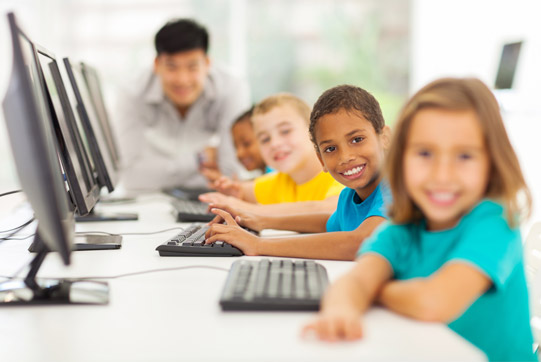
Now-a-days many schools have started to incorporate the technological devices mainly computers in the classroom to enhance the academic performance of students. This is because the use of computers opens the scope to bring in more information to the students.  And this future generation must also learn the functioning of the machinery to compete with this changing trend of technologically driven society. Computers have changed the functioning of the present social order.


Using computers that are individually allotted to students might be considered as blended learning. Herein the teachers make use of different learning methods to deliver his contents. Computers may be used to share assignments, engage in various activities, communication experiences with others in spite of the distance between them, and enhance learning to increase knowledge. Classroom management becomes easy with the introduction of technologically driven education.
This can be practiced outside the computer lab at the general classroom level. This will enhance student’s engagement level in learning activities or completion of assignments. This help the kid to engross the project in hand and to a large extent enhance his learning through freedom of online research. The teacher can make use of computer to revitalize boring chapters of study with the help of modern technology and engage them through participation through fun activities.  Thus computers can be a key tool for the teachers to create an environment of engaging and mentally stimulating classroom.
Read More: Concentration Building Techniques for Kids
Teachers can incorporate several software applications to help students to learn their course modules like word processors, spreadsheets, presentation software and database programs. This enables teachers to create an interactive and fun learning environment by reinforcing computer skills. Teachers may also involve them in creating blogs, podcasts about their subjects in their curriculum for extra credits.
Another area which has been revolutionised by use of modern technology is the world of communication. Teachers can assemble students and subject experts or guides together through virtual connections to clarify all their queries and learn in the process. Similarly, virtual field trips can also be a fantastic learning tool which can be experienced by installing classroom computers.
The world is changing rapidly. In this ever changing scenario the students must be aware of the technological innovations to handle the outside world, away from their classroom. Thus computers are not just for fun and entertainment but have immense educational benefits. Thus bringing in of computers in a classroom is a rational decision to make the students confident individuals to handle and bring the future advancement of the society.
Read More: Tips to keep children interested in a TEFL class
It often happens that teacher encounter students who already have knowledge and proficiency in computer skills. Thus it becomes easy for the teacher to introduce computers in school curriculum. However, there are certain risk involve in doing so. Students may start interacting with dangerous or anonymous individuals. Therefore it is absolutely necessarily to keep a watch by monitoring the use to ensure it is used for right purpose and used safely. Pre & primary students often fall for these traps which should be handled with care.
Thus while computers in the classroom have its several benefits, there are also some disadvantages to its incorporation. As a result public education system often hesitates considering its integration in the learning curriculum. But the computers with its complete access to internet provide a door to the world of learning across the world resulting productive academic research and educational support which are just clicks away.
Teacher training course does build the basic framework of the teachers or trainers to guide students and adopt modern technologies. Thus courses not just only prepare the teachers with modern techniques of learning. They gather knowledge to communication building across the virtual world with the help of technology. Computers benefit student’s learning in a lot many ways. Thus the schools both public and private must introduce for betterment.