Monday, 16 May 2016

Nursery Teachers Must Stimulate Children's Learning Abilities

Nursery teachers who work in pre-school, nursery and reception classes with children of age group three to five must plan out activities that will stimulate their learning abilities. This involves development of work schemes and lesson plans to motivate children and encourage their creativity and imaginations. 
The nursery teachers constantly guide the children to shape their social and communicative skills and provide a supportive environment for learning. They build a rapport with parents or guardians and further stretch their hands of support to ensure all-round development of children. They record observations and summarise children’s achievements in terms of their set goals. 

Since this is the transition stage towards primary school education. Teachers play a very important role in preparing the kid for this shift. Teacher training course prepares the teacher to handle this vital responsibility associated with their teaching job.
 The nursery teachers carry out various job responsibilities in motivating and stimulating children’s learning abilities-
•    encouraging learning through experience
•    providing adequate care and security to walk freely in the classroom
•    making and developing of visuals aids and teaching resources
•    encouraging imagination as a learning resource
•    guiding students in the development of their personal, social and language abilities
•    developing children’s curiosity about learning through stories, songs, games, drawing and imaginative play
•    sharing gained knowledge with other kids in the classroom or with their parents at home
•    observation of each child’s progress by keeping a record of it
•    Besides, the nursery teachers must keep up with the changing curriculum and developments in best practice
Read More : 6 Easy Tips to Keep Nursery School Students Engaged
Not everyone can become a nursery teacher. They must have certain skills and knowledge to perform their teaching job efficiently.
•    Respect and fondness for children
•    Excellent communication skills
•    Excellent organisational skills
•    Good listeners
•    Energy, resourceful, patience and caring nature
•    Ability to work independently as well as with a diversified team members
•    Ability to keep things in perspective
Pre-entry work experience with children is required by employers and it is preferred to be in a school or nursery environment. Other form of experience that is encouraged includes volunteering at a local playgroup or play scheme. Apart from this, background study through regular visit to schools to observe and talk to teachers.
Read More: Computers in Classrooms Benefit Students' Learning
Nursery teacher’s job role is not restricted to teaching. They perform managerial functions in elementary education. Such as
•    Administration: This refers to direction, control and management of human and material resources for overall growth and development of educational sector.
•    Personnel control and management: It involves recruitment, transfer and redeployment, performance appraisal, grievance redressal mechanisms and other issues related to their professional development.
•    Financial Management: Mobilization and deployment of financial resources as per stated objectives and requirement of the time being.
•    Supervision and monitoring: Monitoring and supporting different teaching-learning processes and other activities for development of the school or institution for enhancing the quality of education through methods and mechanisms.
•    Information management: This involves aspects of collection, processing and use of information in most fruitful manner.
Nursery teacher training courses like any teacher training course gives emphasis on development of children in a joyous and free manner. The trained teachers contribute in the learning process of kids and in due course development of the overall curriculum or education structure of a school.  Their contribution towards the early learning goals though involves lot of hardships but are absolutely rewarding. The students develop special bonding with teachers even as they grow up as confident individuals. Then the best option would be to join an internationally accredited institution offering courses for professional and personal development with flexible modes of learning like online and distance. Gift yourself a flourishing career in the field of education with an absolute suitable duration and course fees with teaching practice at the end of the teacher training program.

Monday, 9 May 2016

Early Childhood Education Activates the Child's Natural Desire to Learn

If early childhood education is essential for a kid’s growth then teacher training in India is an absolute necessity for the pre-primary teachers to work on their teaching skills, methodologies and vocabulary. While there have been controversies regarding starting of school at an early age of two to three years.  Experts suggest that early education activates and promotes a lifelong desire and love for learning.  


They had provided with justifications in support of their argument.
  • Early development processes at this early age will prepare them for a classroom environment in school.
  • Various activities in the classroom like reading interesting books, singing songs, finger plays enhance their skills and interest towards learning.
  • Also participating and interacting and communicating with peer groups help to utilize both hemispheres of the brain towards proper growth of the child.
  • Simple mathematical tasks of counting or learning to climb stairs etc are helpful in developing the learning skills.
    The decision to admit a kid depends on the distinct advantages of preschool programs-
  • The programs promote overall personality growth of a kid with the help of social, mental, physical well-being.
  • It increases a sense of independence, self confidence with the adults and other children outside their safe zone of household.
  • They get complete freedom to explore and experiment, discover and innovate while they participate in an engrossing activity.
  • They get the outlet to express themselves freely and constructively.
  • Preschool cultivates those skills that are needed to succeed in a higher level of study in school through linguistic skills or conceptual games.
  • They develop an understanding of the authority and develop self control and discipline in their attitudes which helps them a lot in facing the world outside.
  • The classroom is designed such that it can encourage responsibility towards oneself and his or her actions directed for others.
    But there are certain misconceptions about early learning such as-
  • Children do not like to learn rather their innocence is hampered if forced to indulge them in various activities of concentration.
  • The kids cease being kids as their spontaneity is marred and are forced to adjust with the old school norms and regulations. This is too early for a kid to adopt and adjust to the real life conditions. Rather they are forced upon to involve with the process of learning.
It can be suggested that learning at young age has its own pros and cons. The children generally are fun loving in nature. When learning is in disguise of playing it could be fun and captivating rather than challenging or boring. Honestly, the first thing that the kid face while starting out in the beginning is a sense of separation and anxiety from their parents and loved ones. But once they get familiar and get adequate personal attention from the teacher, they develop an attachment with the school. Then attending school becomes fun for the kid. Though there are parents who like to keep their kids close to them thinking they themselves can teach them instead of leaving them in a preschool. This concept must be challenged in a modern setup of a school. On one hand, preschool enhances learning skills and have immense educational advantages, on the other, overall growth of the kid is triggered through various activities. Herein, the early childhood teachers play a pivotal role. He/ she are the guiding stars in the life of the kid. He/she is never impatient rather gives complete care and love to the children making it a second home like feeling for them.
Pre-primary teacher training will be your route to fulfil your desire to become a teacher.  Be the best in your own domain as teaching is not an easy task but can be truly rewarding.

Saturday, 7 May 2016

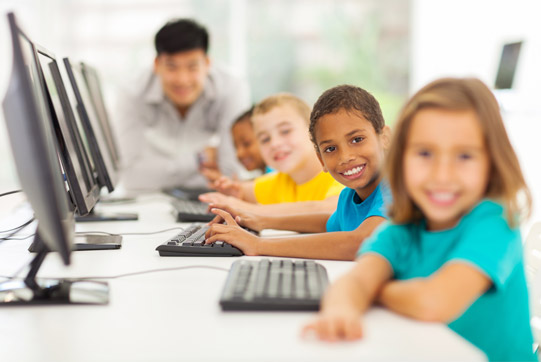
Computers in Classrooms Benefit Students' Learning

Now-a-days many schools have started to incorporate the technological devices mainly computers in the classroom to enhance the academic performance of students. This is because the use of computers opens the scope to bring in more information to the students.  And this future generation must also learn the functioning of the machinery to compete with this changing trend of technologically driven society. Computers have changed the functioning of the present social order.


Using computers that are individually allotted to students might be considered as blended learning. Herein the teachers make use of different learning methods to deliver his contents. Computers may be used to share assignments, engage in various activities, communication experiences with others in spite of the distance between them, and enhance learning to increase knowledge. Classroom management becomes easy with the introduction of technologically driven education.
This can be practiced outside the computer lab at the general classroom level. This will enhance student’s engagement level in learning activities or completion of assignments. This help the kid to engross the project in hand and to a large extent enhance his learning through freedom of online research. The teacher can make use of computer to revitalize boring chapters of study with the help of modern technology and engage them through participation through fun activities.  Thus computers can be a key tool for the teachers to create an environment of engaging and mentally stimulating classroom.
Read More: Concentration Building Techniques for Kids
Teachers can incorporate several software applications to help students to learn their course modules like word processors, spreadsheets, presentation software and database programs. This enables teachers to create an interactive and fun learning environment by reinforcing computer skills. Teachers may also involve them in creating blogs, podcasts about their subjects in their curriculum for extra credits.
Another area which has been revolutionised by use of modern technology is the world of communication. Teachers can assemble students and subject experts or guides together through virtual connections to clarify all their queries and learn in the process. Similarly, virtual field trips can also be a fantastic learning tool which can be experienced by installing classroom computers.
The world is changing rapidly. In this ever changing scenario the students must be aware of the technological innovations to handle the outside world, away from their classroom. Thus computers are not just for fun and entertainment but have immense educational benefits. Thus bringing in of computers in a classroom is a rational decision to make the students confident individuals to handle and bring the future advancement of the society.
Read More: Tips to keep children interested in a TEFL class
It often happens that teacher encounter students who already have knowledge and proficiency in computer skills. Thus it becomes easy for the teacher to introduce computers in school curriculum. However, there are certain risk involve in doing so. Students may start interacting with dangerous or anonymous individuals. Therefore it is absolutely necessarily to keep a watch by monitoring the use to ensure it is used for right purpose and used safely. Pre & primary students often fall for these traps which should be handled with care.
Thus while computers in the classroom have its several benefits, there are also some disadvantages to its incorporation. As a result public education system often hesitates considering its integration in the learning curriculum. But the computers with its complete access to internet provide a door to the world of learning across the world resulting productive academic research and educational support which are just clicks away.
Teacher training course does build the basic framework of the teachers or trainers to guide students and adopt modern technologies. Thus courses not just only prepare the teachers with modern techniques of learning. They gather knowledge to communication building across the virtual world with the help of technology. Computers benefit student’s learning in a lot many ways. Thus the schools both public and private must introduce for betterment.

Wednesday, 4 May 2016

Living and Working in Thailand as an EFL Teacher

TEFL course Thailand fulfils your dream of travelling abroad with a job to cater to your monetary need. But while you travel places especially in regions of exotic Thailand you must keep yourself updated with the culture and living standards. This will help you to be in sync with the trends and the people precisely the students’ mind set.
When you will enter an ESL classroom you will get acquainted with cultural diversity, variety of language and taste and habits. The teacher must know how to generate interest in the classroom and make them listen to him or her. Another important aspect is that some of the students are quick learners when individual attention is given while some achieve best when put in a group of few members. Understanding their needs the teacher should take up relevant activities.


An EFL teacher’s job is also to manage classroom wherein some students are fast learners while some take a lot of time in understanding or adapting a language. In this situation based on the level of the students, break the learning task. For students weak in understanding the emphasis should be given on their communication and gradually on the grammatical aspects. While fast learners must be put across various task mostly to check their grammatical knowledge and linguistic skills.
Read More: Tips to keep children interested in a TEFL class
In an atmosphere of immense diversity the TEFL teacher must act confidently. Seemingly he/she must know everything about managing class and must upgrade oneself with new changes of the language.
Living and working in Thailand as TEFL Teacher is going to be smooth and easy provided you are fully aware of the situations beforehand. Here are some insights on the Thai culture and living standards that will help you with an understanding-
  • Almost 68 million people are living in Thailand. Apart from demographic minorities there are Sino-Thai (Thai- Chinese) community living in Thailand mainly in Bangkok. This mixed breed of population are highly accommodating to outsiders or visitors.
  • Thai is the official language of all people in Thailand. It is a mandatory subject of learning for all school children. The tourism industry has people who can speak fluent English yet older population, both the urban and rural population rely on their own language. So while you are preparing to relocate to Thailand consider attending a Thai class.
  • Thailand’s economy is going through transition. In October 2011 it saw a downfall due to flood and after a huge gap, again in the year 2015 it finally showed the signs of recovery. Since a larger portion of the population is involved in the agricultural sector, teaching scope is huge in the rural sector. Herein, complete support for accommodation of the teachers is given by the school authorities. And the people are over enthusiastic to send their kids to school.
  • There are certain labour restrictions on foreign workers or employees, of which you should be aware before you start working in Thailand. According to Foreign Business Act, outsiders should not be working in Thailand’s any sector of employment as office assistants. Though teaching gets clearance and considered as a lucrative sector having adequate pay package. So while you are teaching if you get any offer to earn an extra with any construction company or elsewhere, avoid doing so.
  • Work Visas for Thailand is also another important aspect. Make sure you have signed employment contact and a B visa that includes work permit. These are the basic necessities of living in Thailand and working legally.
 Read More: Design Games to Teach Grammar to Young Learners
As mentioned above, you should keep these few things in mind when you decide to start living and working in Thailand. An online TEFL course could be your ticket to move to Thailand and fulfil your dream of teaching in a place where education is at a challenging condition when it comes to its socio-economic-political conditions.

Wednesday, 27 April 2016

Design Games to Teach Grammar to Young Learners

Games are the most engrossing and interesting activity of language learning for young learners. Games do not put any form of stress, so children participate with ease without any anxiety and it is motivating as well. Since most of these activities are known to them they grow a level of familiarly they link back to these tasks.
The games mean the world to children and are generally all inclusive in nature. Playing games is always fun for children and the best learning method for young learners is to learn with games. Like the guessing game which can be played numerous times which the students would participate happily without getting bored with its repetitive nature. Games are simple structured activities involving little language terms that are effective for students. They will get involved and thus will build a strong association with grammar.

When a child is beginning to learn a foreign language games play a valuable role in it because while learning a new language the child requires a certain amount of time to adjust and adapt the language. Sometimes children take some time in producing language and will gladly experiment and at other times children remain shy and they need more attention and time. This phase is called the ‘silent’ time period when they develop a liking and gradually learn to produce language without any external pressure. The games are also important in terms of generating social skills through activities wherein they share and mingle with their peers. Thus games teach young learners the art of coexistence and collaboration.
Games are generally designed to enhance any part of the lesson and can also be used to practise, revise and assess any language. Those are used to develop the listening, speaking and reading and even writing skills of kids and the responsibility lies with the teacher wherein the focus has to be given. Choosing the right grammatical exercise for the children to practise and deciding on the specific games is your task as a teacher. Making it enjoyable pass times through various activities should be your goal. Thus games are clearly those learning activities which not just enhance student’s language development but leads to overall personality development of the kids.
Read More : Montessori Classrooms Should Be Buzzing With Activity
There are wide varieties of games which can be used for young language learners. Let us bring our focus on a few of them:
First, the flashcard games which are played with a set of flashcards prepared by you and your students in the classroom or can be bought from a bookstore. Games include - listen and find, disappearing picture or words, running games, swat, pass the card etc.
Second, there can be ball games played with soft ball without worrying about breaking window glass or hurting students. Like - say a different colour/animal etc.
Third, action games can also be experimented which involve movement inside classroom. This can be exciting but must be carefully chosen when to make use of them. Like - Robots, In/out – hot/cold, step on the card, hit the card.
Thus games play a special role in any language learning for young learners. It has become more demanding for teachers and learners like any other innovative process helping towards development. Games particularly provide enjoyment and relaxation and also encourage students to learn grammar in a most creative way. This has thus become a natural part of young learner’s lives. It can be concluded that designing games for teaching grammar to young learners has several advantages when those are properly implemented in the classroom. Games help students focus on learning and using language properly.

Thursday, 21 April 2016

Pre-primary Education is Key for Future Learning

Pre-primary education builds the base for future learning and therefore, the teaching methods employed help young children to take the first step towards the formal education. Explained below few reasons why the children should be provided pre primary education-
  •  Preparing the children for future school and higher education as this builds the base for the future education.
  •  It helps the child to express his/her innate skills and that develops his/her personality. Thus it leaves a positive impact on the child overall growth.
  • They get the exposure of their creative side with the participation in various activities and thus it leaves an impact on the personality in the most natural way.
  • The child learns to interact with peers and adjust to the real life situations in a classroom. Thus he/she finds a life outside the closed door of his/her home. This is the first step in gaining independence for the kids.
  •  Pre Primary education targeting all kids from age group of 3 to 5 before they start their primary level education. This stage of learning is to introduce them to the school-type learning environment. This only covers three vital years of a child’s life. With the completion of this stage the kids continue with the education to the next level called the primary education.


Research has been conducted which revealed that pre primary education is absolutely necessary to develop a strong base for the primary level of education. They become more confident and independent which help in their overall growth and development.
Read More : DIY Ideas for Decorating Primary Classroom
Since this is the first exposure to the outside world being separated from the comfort zone of their home. So the school ambience must be comfortable where the kids would feel at home, a place with adequate materials to keep them engaged and they feel the warm and secured just as they feel with their parents. Herein for the first time he/she learns about their names along with the names of things and friends. The kids learn to interact with their teacher and also among themselves and the teacher. The skills and knowledge developed during this phase have huge impact on the child aptitude and attitude later in his/her life.
Children learn a great deal in preschool. The importance is given on the cognitive development of the child as learning is mostly through practice and interaction in a big group. Social interaction is the prime motive of a preschool classroom. They slowly but steadily learn to mix and mingle with the children of their own age under supervision of a teacher. Drawing with the help of colours, playing with mud, writing on the board help in motor development of the children and thus the children are prepared for the formal schools. All these activities are performed under the direction of a teacher who is qualified and trained in handling young learners’ with efficiency.
Read More : 6 Easy Tips to Keep Nursery School Students Engaged
Pre primary teacher are trained in early childhood education and instruct using different methods like storytelling, playing and art. Working with kids is most challenging and tolerance and sympathy are the most essential qualities needed to work with kids and their parents. Creating a friendly atmosphere is absolutely necessary to generate interest among kids to attain goals and all these qualities can be obtained through a proper training in an institute. A working knowledge through observed teaching practice during training session is of absolute necessity but along with this you must have the passion for teaching, love for kids and the rest you can gain over time. Over years pre primary education has been given utmost importance in our country. Ample number of institutes has mushroomed over the years and all you need to do is choose that suits you well both in terms of curriculum and fee. The certification must have global acceptance for a brighter future in teaching.

Friday, 15 April 2016

How to Teach Kids to Write

A kid begins her/ his journey of writing as he/ she learns to write with the colourful scribbles. Indeed, it is a treat for the eyes of the preschool teachers as well to look at the joy that comes over a child's face when he/ she is offered a pencil and a blank piece of paper. As soon as a kid can grasp a pencil and wave his hands over a blank piece of paper he has the ability to make marks. One of the most valuable things a teacher can provide the child is a supportive, stimulating and happy environment.


There is a right way to teach the child to write and make the jump to writing their names and the letters. A lot of writing depends on fine motor development of a kid. For most children, the first word they learn to write is her name. Writing is one of the developmental milestones which vary greatly from child to child.
A teacher always needs to encourage a kid’s writing by keeping paper, pencils, crayons, and chalk within an easy reach. The teacher should know many ways to pique interest like he/ she can pour sand onto a tray and show the kid how to trace letters with a finger. It is exciting to see when a child's scribbles begin to look more like real letters. A teacher need to first start with the kids drawing lines and then connecting the lines to form letters like E, X, Y, F. Letters like M, N may be found difficult for the kids to write at the very beginning. Some kids catch onto learning letters very quickly and others need more repetition and time learning letters. The teacher needs to give the kids more time to understand the letters formation. Sandpaper letters are an integral part of the Montessori approach to learning how to read and write. These letters provide a visual way to help children learn the alphabet shape. Creating an alphabet book is a fun way to capture all the first writing attempts of the child. A teacher may find that after a few months the child suddenly recognizes every letter. One way to keep the alphabet writing enjoyable is to include games and crafts. The kids need a variety of activities to stimulate their interest and to reach them the way that they learn best. When the kid is ready to begin writing her/ his name the teacher can write the letters in large letters on a big sheet of paper. Later on the teacher can add the traditional written form with the first letter capitalized and the rest lowercase when you teach her to write her name and can use multisensory practice tracing over the letters. Montessori teacher training provides with a big set of ideas for the kids which the aspirants learn and implement in the classrooms which he/ she can pick knowing what works best for your kids.